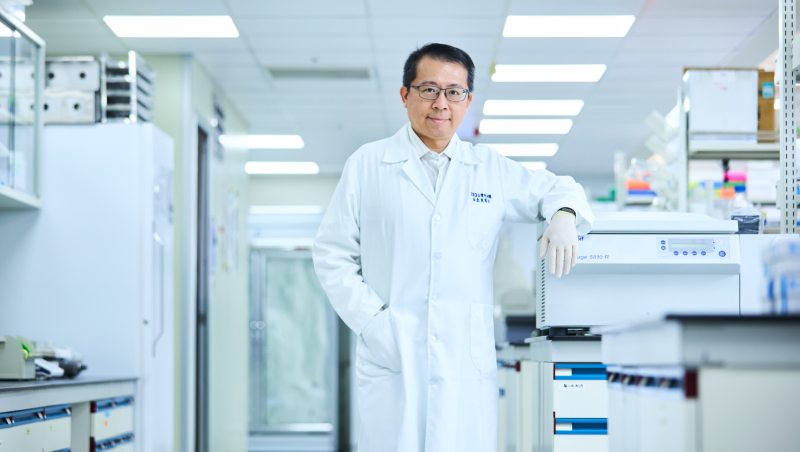
Dr. Lin Jie-liang, COO and CTO of Taiwan Exosome Co., Ltd.
Deepening Industry-Academic Cooperation to Compete with Global Giants
In addition to showing proactivity in new drug development, Taiwan Exosome Co., Ltd. has never stopped its R&D pace, despite its technology already being in a leading global position. "We need to run faster than international giants, which requires close industry-academic cooperation with domestic academic and medical circles that have strong medical technology, achieving results through the alliance of the strong," emphasized Dr. Lin Jie-liang, COO and CTO of Taiwan Exosome Co., Ltd.
Taiwan Exosome Co., Ltd. has already provided clinical cells to Linkou Chang Gung Memorial Hospital and Tainan National Cheng Kung University Hospital for Phase I clinical trials of colorectal cancer, and Phase I and II clinical trials for pancreatic and cholangiocarcinoma, respectively. Recently, in response to Taiwan's status as a "Kingdom of Dialysis," the company signed an industry-academic cooperation agreement with the Department of Life Sciences and Institute of Genome Sciences at National Yang Ming Chiao Tung University (NYCU). This combines biotech industry power with top academic research energy to focus on the R&D and application of exosome technology for urinary system-related diseases.
Hung Chi-chang, Chairman of Taiwan Exosome Co., Ltd., who long promoted the "Two Laws of Regenerative Medicine" during his tenure as a legislator, pointed out that as an R&D-oriented enterprise, the company focuses on developing "clinical-grade non-genetically modified and universal NK cell preparations" and NK cell exosome manufacturing processes. This establishes operational advantages in immune cell preparations, exosome R&D, and academic-medical clinical validation. For animal experiments on urinary system disease models, the company draws on NYCU’s scientific and clinical research, hoping to verify the "reversible" mechanism of exosomes in regulating urinary system inflammatory responses and supporting microvascular and tissue repair.
"This industry-academic alliance can accelerate the process from animals to human clinical trials. It is expected that pre-clinical validation and regulatory compliance will be completed within 2 to 3 years, eventually expanding to multiple applications such as bladder repair, kidney regeneration, and prostate improvement," Dr. Lin Jie-liang further pointed out. Based on existing clinical-grade processes and product development capabilities, Taiwan Exosome Co., Ltd. will gradually introduce NYCU’s clinical research scenarios, including technical validation and safety assessments for disease models like acute kidney injury and urinary tract mucosal injury, with plans to evaluate expansion into areas like bladder repair in the future.
Although research on exosomes is still developing, it is seen as a potential dawn for future disease resistance and tissue repair. With rigorous scientific validation, it has the opportunity to bring new hope to patients worldwide. Hung Chi-chang also expects that with the domestic promotion of the "Two Laws of Regenerative Medicine" and the "Healthy Taiwan" policy, the R&D and application of exosomes will move toward industrialization as regulations fall into place and the development environment improves. Coupled with Taiwan's superior medical technology and comprehensive National Health Insurance database, the overall exosome industry is poised to become Taiwan's second "Silicon Shield."